
What Is a Pressure Transducer? Working Principle, Types & How to Choose
Table of Contents
A pressure transducer is an instrument that converts pressure into a proportional electrical signal — typically 4-20 mA, 0-10 V or RS485. It is the workhorse of industrial pressure measurement, found in hydraulic systems, pumps, compressors, process plants and OEM machinery. This guide explains what a pressure transducer is, how it works, the main types, and how to choose one for your application.
What Is a Pressure Transducer?
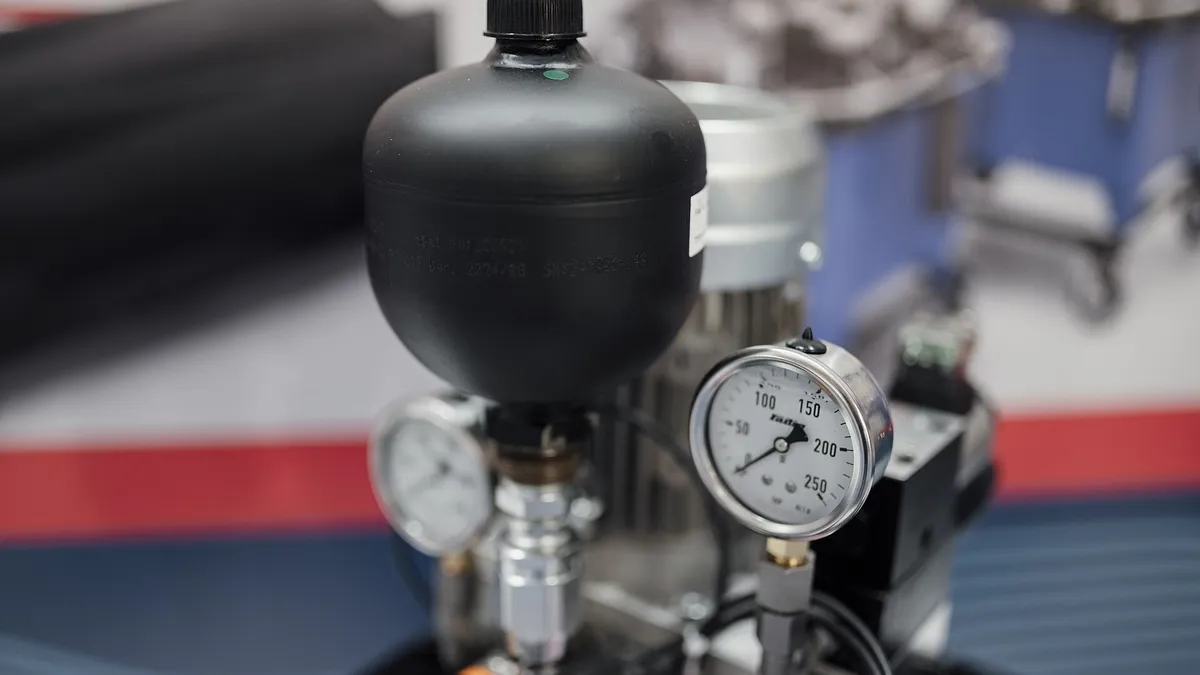
A pressure transducer measures the pressure of a fluid or gas and outputs a standard electrical signal that a PLC, controller or display can read. Inside, a sensing element (usually a strain gauge or piezoresistive chip on a stainless steel or ceramic diaphragm) deforms under pressure; the deformation changes an electrical property, and signal conditioning circuitry converts that change into a linear output signal.
The result is a complete, ready-to-wire instrument: apply pressure, and the output changes proportionally across the calibrated range. A 0-10 bar transducer with 4-20 mA output, for example, reads 4 mA at 0 bar and 20 mA at 10 bar — the signal is directly proportional to pressure.
Pressure Transducer vs Pressure Sensor vs Pressure Transmitter
The three terms are often used interchangeably, but there are technical distinctions worth knowing when you compare datasheets:
- Pressure sensor — the raw sensing element that converts pressure to a small electrical change (resistance, capacitance). It needs external signal conditioning.
- Pressure transducer — the sensor plus signal conditioning, outputting a usable signal such as 0-10 V or mV/V. Not always amplified to a standard loop signal.
- Pressure transmitter — a transducer with a standardized two-wire 4-20 mA output, designed to transmit over long distances to a PLC or DCS.
In practice, most industrial buyers use "transducer" and "transmitter" to mean the same complete instrument. The important specification is the output signal — that determines how it connects to your control system.
How a Pressure Transducer Works
The sensing element is the heart of the transducer. Two technologies dominate:
- Piezoresistive (strain gauge on silicon) — a silicon chip with embedded resistors deforms under pressure, changing resistance. Most common for industrial transducers: accurate, stable, low cost at volume.
- Thin-film strain gauge on steel — strain gauges deposited directly on a stainless steel diaphragm. Excellent stability at high temperature and pressure, media-compatible with most fluids.
- Capacitive — a diaphragm moves relative to a fixed electrode, changing capacitance. Used for very low pressures and high accuracy in laboratory instruments.
The sensing element sits behind a metal or ceramic diaphragm that contacts the process media. Pressure deflects the diaphragm; the element converts that deflection into an electrical change; a conditioning circuit amplifies, linearizes and temperature-compensates the signal; and the output stage drives the 4-20 mA loop or 0-10 V output. The whole chain is factory-calibrated so the output is accurate across the rated range and temperature span.
Main Types of Pressure Transducers
| Type | What it measures | Typical use |
|---|---|---|
| Gauge pressure | Pressure relative to atmosphere | Hydraulics, pumps, compressors, tanks |
| Absolute pressure | Pressure relative to vacuum | Barometric, vacuum systems, process |
| Differential pressure | Difference between two ports | Filter monitoring, flow, level |
| Sealed gauge | Relative to a sealed reference | High-pressure hydraulics |
| Flush diaphragm | Direct contact with viscous media | Food, pharma, polymerization |
Within each type, transducers are classified by range (vacuum to 600 bar), output (4-20 mA, 0-10 V, RS485, HART), process connection (G1/4, NPT, M20×1.5, flange) and certification (CE, ATEX for hazardous areas).
How to Choose a Pressure Transducer
- Define the media — what fluid or gas touches the diaphragm? Water and oil are fine with 316L stainless; aggressive chemicals may need Hastelloy or ceramic.
- Select the range — choose a range where normal operating pressure sits in the middle third. Accuracy is a percentage of full scale, so oversizing reduces accuracy.
- Choose the output — 4-20 mA for PLC/SCADA and long runs; 0-10 V for short runs; RS485 for multi-drop digital buses.
- Match the process connection — G1/4 and 1/4" NPT are most common; flush diaphragm for viscous or hygienic media.
- Check environment — temperature range, vibration, IP rating, and whether the area is hazardous (ATEX required).
- Verify accuracy needs — ±0.5% for general monitoring, ±0.25% standard, ±0.1% for test and calibration duty.
Pressure Transducer Applications
| Application | What's measured | Typical type |
|---|---|---|
| Hydraulic systems | System pressure, cylinder load | Gauge, high-range, 4-20 mA |
| HVAC & refrigeration | Refrigerant and duct pressure | Low-range gauge, differential |
| Pumps & water supply | Suction/discharge, tank level | Gauge, submersible |
| Compressed air | Receiver pressure, line monitoring | Gauge, compact |
| Process control | Line and vessel pressure | Absolute/gauge, flush diaphragm |
| Oil & gas | Wellhead, pipeline, separator | Explosion-proof, high-temp |
| Test & measurement | Dynamic pressure, calibration | Miniature, high-accuracy |
| Medical devices | Gas/fluid pressure in circuits | Miniature, low-range |
If the process involves a pump, a compressor, a tank or a hydraulic cylinder, there is almost certainly a pressure transducer in the loop — which is why the category has such broad, stable demand.
Pressure Transducer Output Signals Compared
| Output | Wiring | Distance | Best for |
|---|---|---|---|
| 4-20 mA (two-wire) | 2 wires | 1,000 m+ | Industrial, PLC/SCADA |
| 0-10 VDC | 3 wires | < 100 m | HVAC, OEM, local display |
| 0-5 VDC | 3 wires | < 100 m | Legacy systems, automotive |
| RS485 / Modbus | 2 wires + shield | 1,200 m, multi-drop | Digital plants, remote monitoring |
| HART | 2 wires + digital overlay | 1,000 m+ | Process plants, smart calibration |
Choose 4-20 mA for anything that runs into a PLC or across a plant; 0-10 V for simple local monitoring; RS485 when you need to daisy-chain many sensors to one controller. When in doubt, 4-20 mA is the safest default — every industrial controller supports it.
Frequently Asked Questions
What is the difference between 4-20 mA and 0-10 V output?
4-20 mA is a two-wire current loop immune to voltage drop over long distances, with a live zero that reveals broken wires. 0-10 V is a three-wire voltage output for short runs and simple controllers. Industrial PLCs almost always prefer 4-20 mA.
What accuracy do I need?
±0.5% FS is fine for general monitoring, ±0.25% is the industrial standard, and ±0.1% is for test stands and precision process control. Remember accuracy is a percentage of full scale — a 100 bar transducer with ±0.25% FS is accurate to ±0.25 bar.
Can a pressure transducer measure tank level?
Yes — hydrostatic level measurement: a submersible or flange-mounted transducer measures the pressure at the bottom of the tank, and level = pressure ÷ (density × gravity). This is a common, cost-effective level solution.
How often should transducers be calibrated?
Typical recommendation is once every 6-12 months for process instruments, or after any suspected overpressure event. PRESSUREPOINT offers NIST-traceable recalibration with certificate.
What is the typical lead time?
Standard models ship in 7-15 days; custom OEM builds in 15-25 days after drawing confirmation. MOQ from 10 pcs for standard models.
Conclusion: Start with Your Application, Not the Spec Sheet
A pressure transducer is a simple, reliable workhorse when matched to the application. Define your media, range, output and connection — then choose the technology. If you're specifying for a new project or replacing an existing transducer, send us your parameters: our engineers confirm a suitable model with datasheet and pricing the same day.
NEXT STEP
Ready to Spec the Right Pressure Transducer?
Send us your requirements — our team responds within 24 hours with pricing and lead time.
Written by
PRESSUREPOINT TeamPressure instrumentation specialist. PRESSUREPOINT helps engineers and maintenance teams source factory-direct pressure transducers and transmitters.